Sunday, September 16, 2012

Killarney, Ring of Kerry and Dingle


Saturday, September 15  Killarney/Ring of Kerry tour/
Carollyn and Roy at stop along way

After breakfast we climb on the bus and discover the Ring of Kerry, a 110-mile route that traces the coastline of the Iveragh Peninsula and offers breathtaking views.  We see the combination of ocean, islands, mountains, light and ever-changing weather patterns. We want to stop more than we do, but we are lucky because the weather is great, and we can take good pictures from the bus.  Today is Rose and Diane’s birthdays.  We are greeted by our fellow passengers to a round of the happy birthday song in English and then the same song by our guide, Denis, in Irish. 
Rose with Charlie Chaplin statue
Bob with Micko Dwyer - Galic Irish football statue


The first town is Killorglin, where an elegant eight-arched bridge crosses the River Laune.   We find out that the word “kill” at the front of a city name means “church of”.   Farther on, the road descends from high above the bay to the water's edge at Kells, an attractive fishing village with panoramic viewing points.
cows on water's edge at Kells
 
Nancy is loving these creatures 

The next stretch is one of the highlights of the Ring, with outstanding views of the Blasket Islands and the Dingle Peninsula.  On the return to Killarney the route travels through Moll's Gap, where we have a soup and sandwich lunch and Ladies View, named after Queen Victoria's Ladies-in-waiting.  The vistas of lakes and mountains remain magnificent today.  We continue on and return to Killarney. 
Stones representing a Celtic burial site 

What we learned today:  The Sisters of Mercy is called in Ireland “The sisters of no mercy”.  If an Irishman is “chancing his arms” he is taking a risk.  A puck is a male goat.  One of Ireland’s towns has a King Puck celebration.  “Not the sharpest knife in the drawer”, means not the smartest person…  “TT” is a tourist trap. Soil creepage is soil that is coming down the mountain that is soggy.  One of the most important people in Irish history is Daniel O’Connell.  He achieved Irish Catholic emancipation in the 1800s for Ireland.  OAP means Old Age Pension (have to be 65).  At that age you can travel free.  A slurry spreader is a manure spreader.  A bin man is a garbage man.  Retail therapy is shopping.  What Denis isms.  ISH

Rose trying to get out of the trap
 
Carolyn playing golf at Ross Golf course
Celebrating after golfing
 
Today is a special day for Rose.  She and Carolyn get a cab and go to the Ross golf course, where we play 10 holes—yes an extra hole!!  The weather holds well, and it is so much fun that we walk back to the hotel.  We stop for a celebratory Irish coffee and then join the rest of the group for a talk in the hotel given by a local farmer on what it was like to be a farmer in Ireland. 
Birthday dinner at Hennessey's
Jim, Bob, Roy, Carolyn,
Diane, Phil, Rose, Nancy
Bailey's and Coffee with Irish Shamrock


We then go to Hennessey’s bar for dinner.  Everyone dined on elegant food.  My favorite was the salmon, and Bob’s the hamburger.  Others had duck and lamb.  It was a great way to spend our birthday!!  Right Diane!!

Sunday, September 16 Killarney/Optional Dingle Experience tour

Irish countryside around Dingle
 

Today we are back on the bus after breakfast to take the tour to the Dingle Peninsula.  First stop is at Tralee's Kerry the Kingdom Museum, to enjoy the fascinating experience of a recreated medieval village.  We follow the rugged Dingle Peninsula with its wild mountains and some of the most spectacular coastline Ireland has to display.  We view the famed Blasket Islands, the most westerly point of Europe, and their prehistoric ring forts and Beehive huts.  One of Ireland's largest Irish-speaking areas, the peninsula has attracted many writers and artists for the inspiration of the wild landscape offers.  The movies Ryan's Daughter and Far and Away were made here.  We stop in the fishing town of Dingle to enjoy locally caught (Pollock) fish and ships for lunch.   In the harbor at Dingle there is one famous dolphin who’s name is fungi.  He has been here since the 1980s. 
Thatch roof house
Traffic jam


On our way to Slea Head, we drive on very narrow road.  The curves are so sharp and narrow, that the cars have to back down for the busses.  We experienced this.  It was a beautiful coastline.  We then stopped in a graveyard to see some the old Celtic remains from 3000 years ago. 

Slea Head
Beehive hut
Bob with fungi dolphin


What we learned today (from Denis):  We saw some “oreo cookie” cows.  They really are black and white and look like an Oreo.  A ballaun casket is a casket used in Celtic times—we don’t know what for.  Corn beef and cabbage is not Irish—it is Bacon and Cabbage that they eat here.  When the Irish immigrated to America, they lived next to Jewish people and they had the corn beef, so they put it with the cabbage.  You can’t find corn beef and cabbage in Ireland.

City of Dingle 

We then returned to the hotel to have an early dinner and to bed so we can be on the road by 9:00 in the morning for Cork.


Thursday, September 13, 2012

Connemara, The Burren & Cliffs of Moher


Thursday, September 13  Galway/Optional Connemara & Kylemore Abbey tour


After breakfast, the entire group journeyed through Connemara region of Galway.  Once home to more than two-million Irish, it still retains its regional heritage, as we ramble around its lakes, mountains, and bogs.
Bob & Mike in the Bog
 
A walk in the Bog
Diane and Phil 

Our first stop was to walk on and look at a blog.  Our guide told us that some bogs contained 2000 year-old bodies.  They cut the bog (which is not a renewable resource) and use it for burning/heating (peat).  We passed by the Connemara Giant statue.  Its inscription stated that “on this site absolutely nothing happened”!

Connemara Giant Statue
 

Rose &Bob at Kylemore Abbey
 

Kylemore Abbey
Bob made me add this--


Carolyn & Roy
Diane, Nancy, Rose, Carolyn in the back of the bus
 
We then visited the former Gothic mansion of Mitchell Henry, now home of Benedictine nuns and better known as Kylemore Abbey.  We wandered through the mansion and the Victorian gardens.  We could have spent more time there. 
Walking through the gardens


We then cruised  Killary Harbor, a fjord-like inlet.  We had a great lunch while cruising.  It was finished off with Irish Coffee or Irish Cream coffee.  It is nothing like what we have in America.  It is much better!! 
Boarding the ship

 
Vicki & Gary on the ship
 

What we learned today:  Our guide calls his wife “the leader of the opposition”.  If you live in Northern Ireland you call it Northern Ireland.  If you live in the Republic, you call it North of Ireland.  There are 10 million sheep and only 6.2 million people in Ireland.    Flashers on a car/bus are called “park anywhere flashers”.  The Famine was really a”great hunger” because there was food but the food was owned by the Lords and they wouldn’t give it to the people.  There were 8.2 million people prior to 1945.  During the famine, 1 million people died, 1 million people emigrated, and over the next 5 years, another 2 million people emigrated.  The Chaktau (sp?) indians helped the starving Irish by donating money to help feed them.

Typical house with stone fences
 

On the return to Galway, we traveled through the Inagh Valley to the coast seeing the deserted village of Clough Na Mara and discover a sense of hardship the Irish experienced in the 18th and 19th centuries.  Only shells of their homes remain.

Dinner in Galway
Jim, Phil, Diane, Rose, Bob, Nancy
 
Leg of Lamb
Nancy & Jim
 

Later, our bus driver John drove us to the city of Galway.  The city spans both sides of the River Corrib.  In the center of Eyre Square stands the Quincentennial Fountain, constructed in 1984 to mark the 500th anniversary of the Royal Charter granted by King Richard III that created Galway as an independent city-state.  Nearby are some of the oldest streets in Galway, narrow winding lanes that curve in and around old wooden buildings, often meandering off toward the Corrib and the docks.  Turn the corner and there is modern Galway.  Artists and musicians crowd the sidewalks and almost every pub seems to offer live music.  We ate at the Busker Brownes.  We had some fabulous food—and of course, pints!!


Friday, September 14  Galway/The Burren & Cliffs of Moher/Killarney

After breakfast, we departed Galway for Killarney.  On the way we discovered the intense natural beauty of Eire to the Burren and the Cliffs of Moher.  The Burren's name is derived from a Gaelic word meaning "stony place" and it is like no other place in Ireland.  Instead of peat bogs and pastures, there is a surreal moonscape full of huge limestone crags.

Green of Ireland
 

A diverse array of plant life, including wild orchids and rock rose, thrives here.  Alpine plants nestle in crevices beside temperate species.  The white, deeply crevassed limestone conceals "micro-environments" rich in potholes and hollows.  The ample rainfall and strange topography have resulted in a paradoxical profusion of artic and semi-tropical vegetation growing side by side.  The roads are narrow and windy, and scary.
 
 
Moonscape in Ireland
 

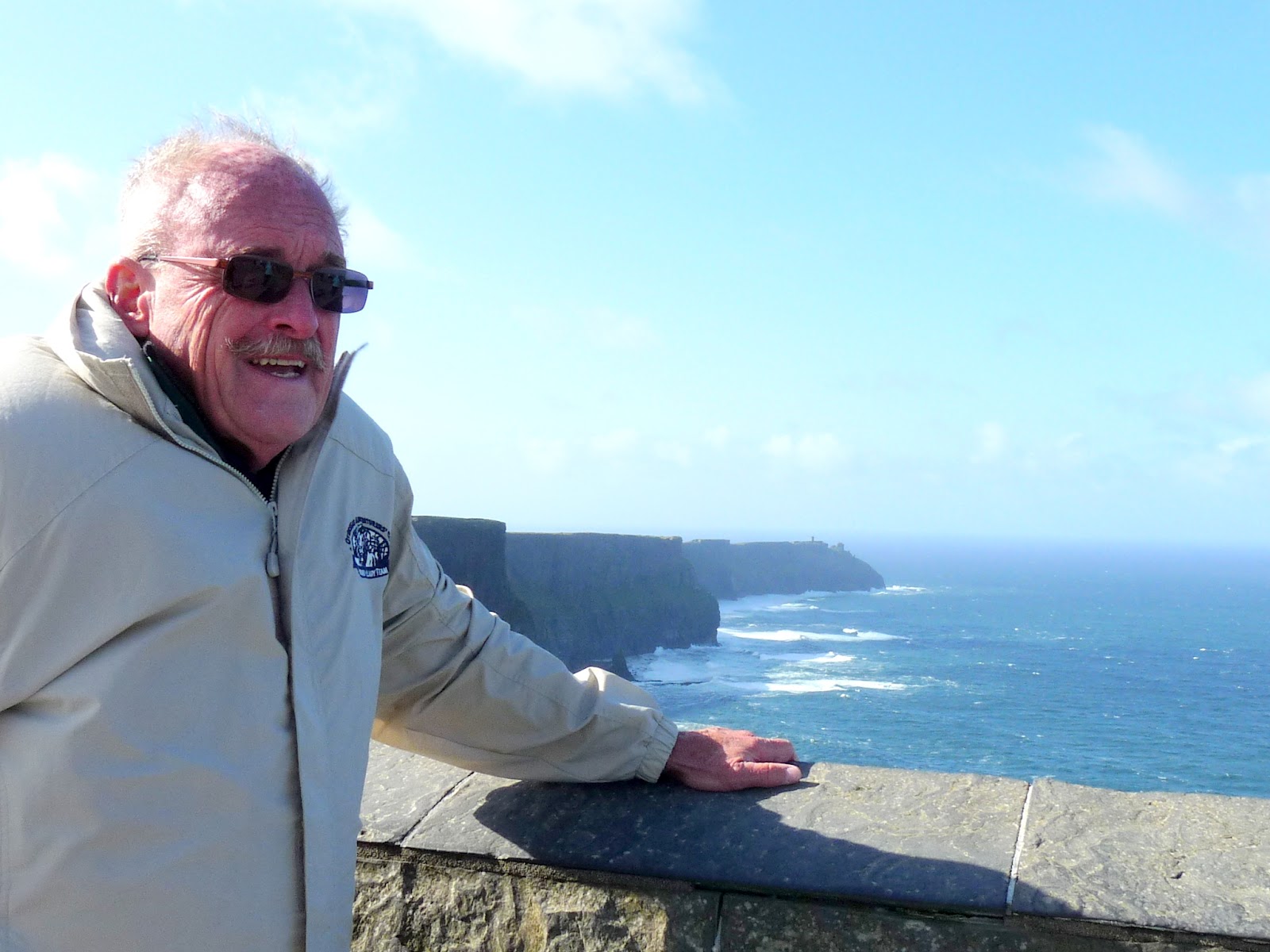
The majestic Cliffs of Moher are precipitous rock formations, towering nearly 700 feet above the crashing ocean surf at their highest point, that offer breathtaking panoramic views of Ireland's Atlantic coast.  These magnificent cliffs provide nesting sites for seabirds.  The wind was very strong today.  You could hardly walk, because a gust would blow you backwards.  It was mostly sunny, though, and the views were fantastic.  The visitors center was really great, with a virtual tour of the cliffs as seen by a bird. 
Cliffs of Moher
 
Bob windswept on the Mohers

 Over the centuries, people have also made their mark, with towers, quarries, and well-worn paths, but they're almost lost in the scale and grandeur of the sea cliffs.  One that does stand out is O'Brien's Tower, a huge structure built to house the guests of Cornelium O'Brien, Country Clare's legendary Member of Parliament from the 1830s until he died in 1857.
O'Brien's Tower
 
"Lovely" ladies at the Cliffs
Rose & Nancy

What we learned along the way:  a half hour such as 9:30 is spoken as “half 9”.  Children in Ireland are called “precious”, such as we are taking our precious to school this morning.  When the bus driver drives on the “cats eyes” (which is the bumpy, separated line along the side of the road), they call it driving through Ireland by Braille.  To make a stop or pull over, you call it a “tuck in”.   Divorced is called “between phases”.  If you “took the soup”, it means that you switched religions in Ireland so you could eat soup during the Famine.  So if someone “took the soup”, they switched sides (to survive).  Public Houses are called “pubs” (makes sense). 

Bus on the Shannon Ferry
 

We boarded a Shannon Ferry and we sailed across to Tarbert in the county of Kerry, Republic of Ireland.  Along the way we saw people playing golf on the windy courses.  Our guide, Denis is from this city, and we will spend the next three nights in Killarney.  The market town is known for its verdant, rolling hills and glittering loughs (lakes).  We are staying at the Killarney Towers.  We took a short walk around the town with the guide and then ate in the hotel.  We had rack of lamb and wonderful veggies and dessert to name just a few things
 
Playing golf on the lynx course
 
 
View above the town of Killarney


Monday, September 10, 2012

Galway


Monday, September 10  Londonderry/Transfer to Galway

Millie, Luci & Bob on bus
 

After breakfast we transfer by bus to Galway on Ireland's west coast.  En route we stopped at Belleek Pottery in County Fermanagh, Northern Ireland, a world-famous pottery works that has been producing fine china since 1857. We took a 25-minute tour of the factory, and I think even the guys liked it.  We got to see how they made the pottery from start to finish.

Gary watching tour at Belleek
 

We learn some interesting facts.  The red hand of Ulster is a symbol of the Celts claiming Ireland.  The first hand to reach Ireland claimed it.  The person coming in 2nd cut his hand off and tossed it on the Island. Thus the red (bloody) hand symbol on the flag.  Galway is the City of Tribes.  We crossed over to the county of Donegal which is in the Republic of Ireland and the colors changed to green and yellow.  We also switched to the Metric System. The license plates on the cars make common sense.  The first two numbers are the year of the car!!  The others are something else that makes sense, but can't remember what Denis said.   St. Patrick’s Day is called P&P (Parade and Pub).  Ireland is the size of Indiana-  Ireland is 32,000 sq. miles and Indiana is 36,000 sq. miles. 

Carolyn by Celtic Cross
 

We had a lunch stop there was a very old Celtic Cross which was displayed in a graveyard and also where the poet Yeats was buried.  A graveyard is always located by a church and a cemetery is not near a church.  We ate at the local cafĂ© there and were able to view Yeats grave.  We had one more stop before we reached Galway at the Knock Shrine which is a sighting (vision with 15 witnesses) of Mary, a lamb, John the Baptist (many years ago) and on this site they built a shrine. 

dinner in hotel
Gary, Vicki, Carollyn, Roy
with Denis, Jerry and Eleanor in background
 

We arrived in Galway late afternoon at the Pillo Hotel Galway.  We all met at 5:00 to have a walk-around and then met for dinner on our own with the group.  Here we said good bye to our driver Jerry. 

rainbow over GCT bus
 

We get to “lie in” tomorrow because we don’t leave for a city tour until 10:30, 


Tuesday, September 11, Galway

Phil & Diane arriving
 
Our group of 21 grew to 38 today.  The last of our group (Phil and Diane) arrived this morning.  We now know how Mary and Charlie, our long-time traveling companions, felt when they greeted us at our various destinations over the years.  Mary and Charlie would go a day early to get acclimated and greet us when we arrived.  They are not with us this time because they are awaiting (patiently) a liver transplant for Charlie in Iowa (they live in Sacramento) and we are praying every day with them that it arrives soon so they can join us again as we travel the world. 
In Galway
 
Shopping
Roy, Nancy, Rose, Carolyn
 
 
Boys at the bar
Steve, Richie, Mike, Bob


The bus drove us to the beautiful city of Galway.  We stayed downtown for about 4 hours, and the weather was simply wonderful.  The rain has let up.  We shopped a little, and the guys mostly sat at the pubs and drank Smithicks while we shopped. 
Gary's new hat
 
Richie the native Irishman
 
Steve the Godfather


Back at the hotel, we met the rest of our group around 3:30 with a welcome glass of wine.  Then on to a dinner in the hotel.  Many walked after dinner and others retired.  Tomorrow, we will be doing more site-seeing.
 
Irish wolfhoud and buddies
 
Our fearless guide Denis
 
 
Wednesday, September 12, Galway, Walking tour/ Optional dinner and Ceili tour

Bob kicking the wall at Salthill
 
Diane, Steve, Luci by the Seaside
 
 
Today we all boarded the bus at 9:00 to drive to the sea to kick the wall at Salthill.  Salthill is a traditional seaside resort that is a suburb of Galway.  In the early years, the ladies would walk the promenade and when they got to the end of the wall, they would kick it and then turn around and walk back.   After kicking the wall, we drove to the cathedral in Galway that was built in 1965 by Cardinal Cushing.  There is a memorial in this cathedral for John Kennedy.  It only cost $1 million to build the church—all paid for by England.
 
 Galway Cathedral
Cardinal Cushing on left, JFK on right
 

We walked across the street from the cathedral to visit the statue of the lading emerging from the stone--which symbolized equality emerging.  We then went to the marble factory in Connemara.  The marble there is only found in Ireland.  After the tour, we were able to buy some of the jewelry and other items made of the marble.  The last large contract for this company was the cathedral that we visited earlier.  They now only use the marble for small projects and jewelry.  After this tour, we went across the street to visit their welcome center.  In this center were some pieces of blue willow—but not for sale!!  The bus then took us to Galway were we had lunch.  We ate at the Kingshead Restaurant for lunch and then did some more shopping. 
Emerging Equality
Connemara Marble factory tour
Lunch at Kingshead
Bob, Nancy, Rose, Diane, Phil
 
 
Things we learned today--Good Morning or God Bless is Dia Guit (God Bless).  The car windshields are called windscreens.  Cars are 1/3 higher in Ireland that in the US because of Irish taxes.  Realtors are called Auctioneers in Ireland.  Instead of going to Google, you go out to "paddy".

We joined the rest of the people at 2:30 in Eyre’s square and did a walking tour with Denis through the city.  The city is a medley of narrow lanes, wood and stone shop fronts, and bustling restaurants and pubs.  Originally presided over by the local O'Flahertys, Galway was taken over by Anglo-Normans and became a thriving center of trade and commerce by the 14th century.  European galleons were a regular sight in the city, which was even home to the Spanish Armada during its western voyages.  Galway declined after being damaged in battle with the forces of Oliver Cromwell in the mid-17th century but regained its prosperity and vitality in modern times.  Today Galway remains a merchant town, but it is also a burgeoning center for technology and a lively bohemian mecca.  We returned to the hotel around 4:00 tired, but ready to embark later for the city for dinner.
Steve enjoying watching the river
 
While the others ate around the hotel, a group of people left for the optional Irish ceili, a celebration of the harvest that included a hearty meal followed by song, stories, and dance. Mike Coughlin was picked to join the dancers and they watched the sun go down on Galway Bay.  This was a three course dinner.
Eleanor in front of restaurant awaiting the entertainment
 
Mike kicking up his heels